
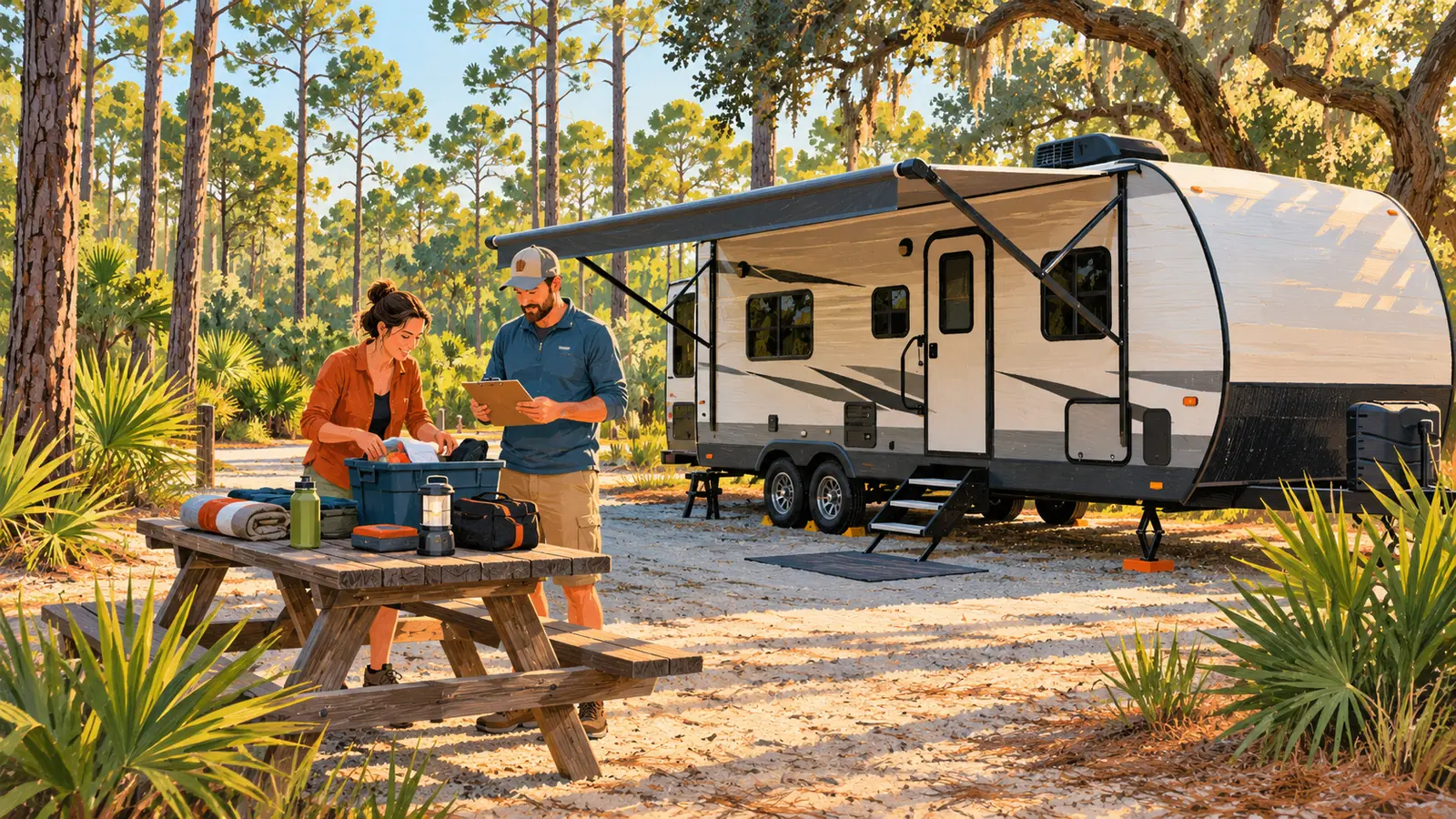
Use a short shakedown trip to practice RV setup, meals, sleeping and departure before a longer journey. Choose a verified campsite and leave time to repeat the basics.
For your first outing, camp at the campground closest to home so you can work out the kinks. If anything major goes wrong, you're close to home, your tools and whatever you need to fix it. Make your second outing a farther one.
Plan two nights if your schedule and the campground's rules allow. Arriving, staying for a full day, and departing gives you a chance to test both the household routine and the travel-day routine.
Define a small set of questions
Choose a few things you want to learn. Can both adults follow the arrival procedure? Does the sleeping arrangement work for everyone? Can you prepare ordinary meals with the equipment you brought? Does the work connection function at the actual site? Are essential supplies easy to reach?
Resolve safety, maintenance, loading and operating questions before you drive. Arrange any needed inspection or repair before the practice weekend.
Write the questions in a notebook and leave space for observations. A note such as “the breakfast supplies were split across three cabinets” is easier to act on than “we need to be more organized.”
Choose access and support before attractions
Look for a site that fits the complete RV configuration and offers the services you intend to use. Confirm the approach road, check-in procedure, operating status, and current conditions through official sources and the campground.
For an initial trip, a straightforward developed campsite can reduce the number of new problems to solve. You can learn normal utility use, household timing, and packing without also learning remote-road access and off-grid power management.
Identify relevant help nearby, but do not assume a business will be open or able to handle your RV. Save official contact details and check availability for the kind of support that would matter. The useful backup may be returning home rather than arranging a complex repair during the weekend.
Check whether Lake Louisa fits your weekend
Consider Lake Louisa State Park if its Central Florida location fits your route, then check the exact site and dates. The park's official campground page lists sixty full-facility sites with 30- and 50-amp service, says some sites can accommodate rigs up to fifty feet, and identifies a campground dump station. Those details help you compare options; they don't confirm that a suitable site is available for your trip. Lake Louisa campground information
Check the specific site's dimensions, configuration, services, and current park notices. “Some sites” does not mean every site fits the same rig. Do not translate “full-facility” into an assumption that each site has every connection you expect; verify the exact listing.
Compare Lake Louisa with the other campgrounds on your list. Choose it if the drive is manageable, the specific campsite fits, and you have a workable backup for your household.
Check Lake Kissimmee's closure notice
Check Lake Kissimmee State Park's current closure notice before planning a camping stay. On October 2, 2026, the park's official main page displayed a campground closure for renovations effective February 17, 2026. Camping descriptions can remain online during a closure, so wait for the official park to confirm reopening and availability for your dates. Lake Kissimmee current park notices
Check the park’s main alerts as well as its campground and fee pages; amenity descriptions may stay online during a closure.
If you'd like to try Lake Kissimmee later, keep it on your list and recheck the official reopening notice and availability before planning a stay.
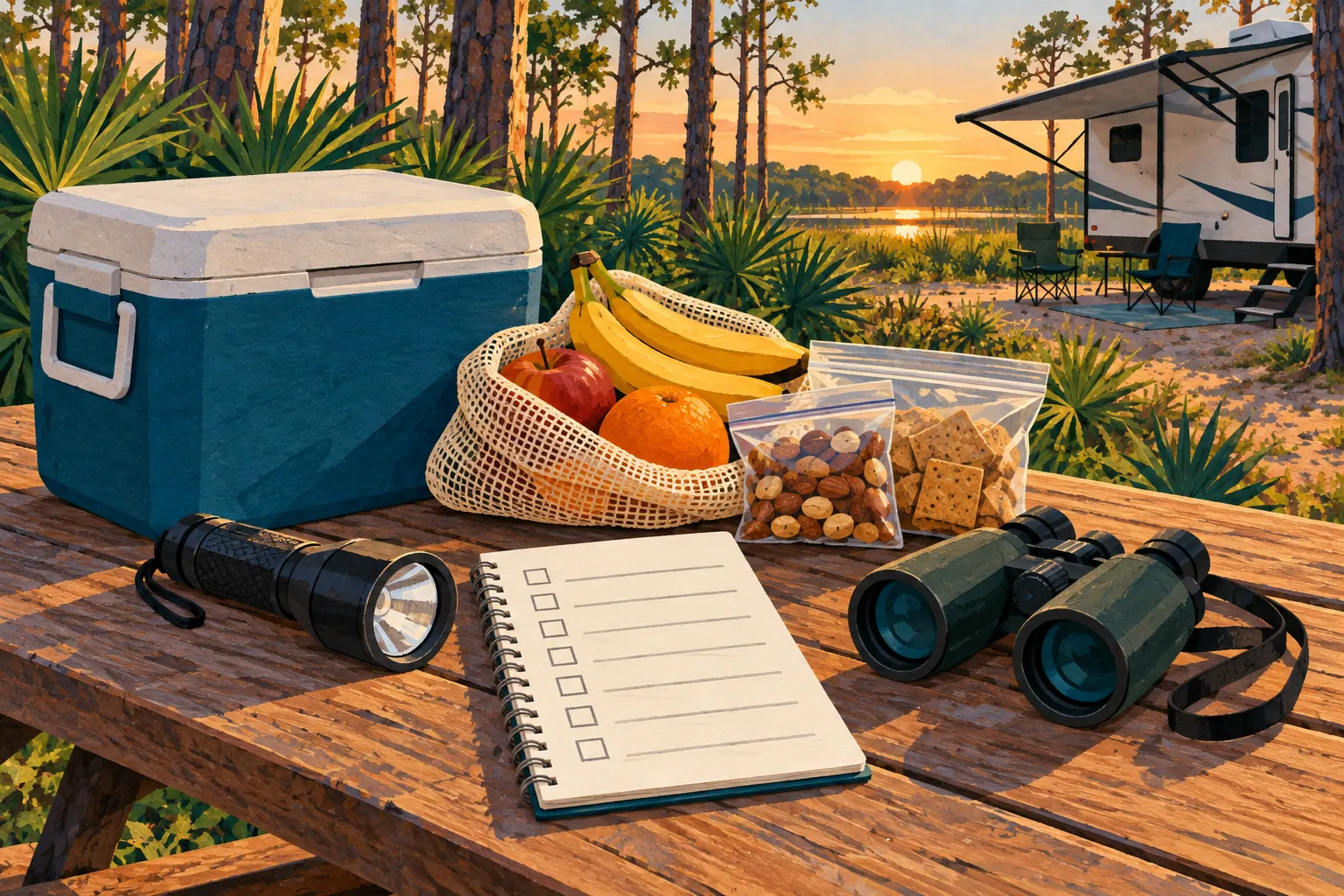
Confirm the complete booking details
Use the current central Florida State Parks reservation information alongside the exact campsite listing. Booking windows, fees, cancellation conditions, and arrival instructions can change, and older park subpages may retain earlier wording. Resolve any conflict with the park or reservation service before paying. Florida State Parks reservation information
Price the actual party and dates. Save the total, cancellation terms, check-in window, and late-arrival process. If a weather change or unresolved RV issue makes the trip unsuitable, you should understand the financial consequences before deciding.
Aim for a daylight arrival with margin. Check road conditions before leaving; Florida's official 511 service provides traffic information that can support the route review. It does not replace checking RV-specific road restrictions or the campground approach. FL511 information
Keep the first evening deliberately simple
Arrive, confirm the site, and follow the setup procedure in the correct manuals for your RV and equipment. Give each adult a role and keep children and pets supervised outside the maneuvering area. Take the time the setup needs rather than racing a thirty-minute target.
Make an easy dinner with familiar ingredients. Check whether the kitchen supplies, seating, lighting and cleanup arrangement work for five people.
Before bedtime, locate the relevant emergency information and verified weather-shelter plan. Check that everyone understands the basic sleeping arrangement and where essential items are kept. Write down inconvenient discoveries while they are fresh.
Give the middle day a loose structure
Use the morning to repeat ordinary tasks: breakfast, dishes, getting dressed, and any work or learning commitments the trip is meant to support. Pay attention to bottlenecks rather than assigning blame. If everyone needs the same small space at once, the schedule may need changing more than the floorplan.
Choose one technical learning task that can be performed safely within the owner instructions, such as understanding the normal monitor display or locating the correct manual section. Do not create faults, bypass equipment, or experiment with unfamiliar connections to see what happens.
Leave time for an easy outdoor activity and a quiet stretch back at camp. The family's reaction to unstructured time is part of the test. A successful RV weekend does not require constant sightseeing.
Separate urgent concerns from convenience fixes
Keep an issue log with three categories: stop and obtain help, resolve before the next trip, and improve when convenient. Use qualified guidance to classify anything that affects safety or equipment operation.
An unexplained electrical smell, a significant leak, or a problem securing the RV should not be deferred because it belongs on the weekend's list. Stop using the affected system and seek the appropriate assistance. A missing dish towel can wait.
For each non-urgent issue, write the observation, when it happened, and what you need to learn. Avoid buying a product immediately for every inconvenience. You may discover that a different routine solves the problem with the equipment already aboard.
Rehearse departure without a packed afternoon afterward
Allow enough time to complete the equipment's departure procedure, the interior checks, and a final walkaround. Use the same checklist you intend to use on a longer trip. Do not rely on memory because the drive home is short.
Give the family an uncomplicated destination after checkout. A tight appointment can turn the most useful practice session into a rushed departure. If possible, keep the return day open enough to unload and note what needs attention.
After arriving home or at the next confirmed stop, review the notebook together. Choose a few specific changes and assign an owner and a next step. Book qualified service where required, revise the packing or arrival routine, and decide whether another short test would answer remaining questions.
Researched practical guide · The RV Dummies · Editorial review: 2026-10-02.
Sources & further reading
Always follow your RV and tow-vehicle manuals. When in doubt, ask a pro.