
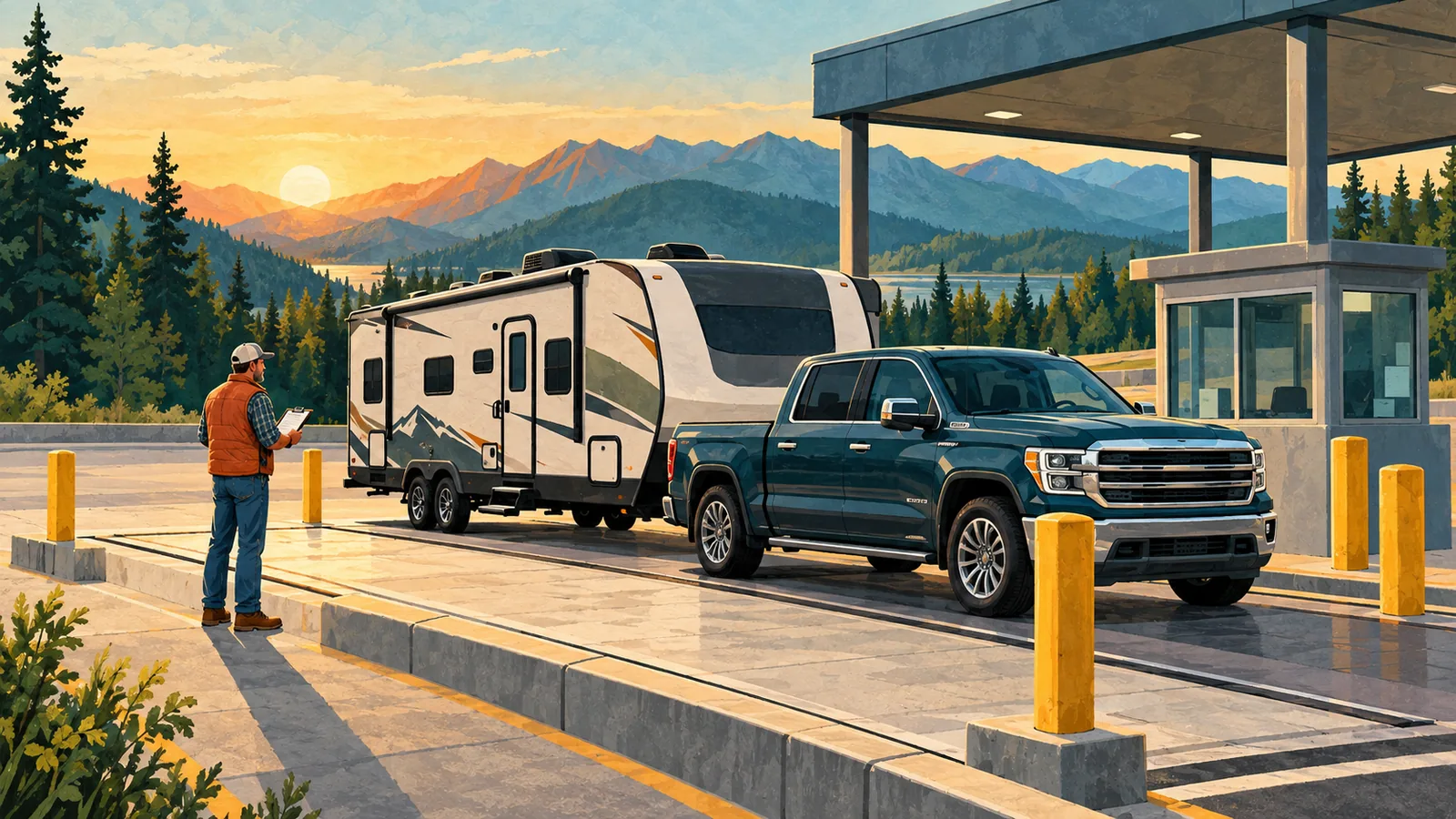
An RV weight plan starts with your actual vehicle, your actual tires, and the way your family really travels. Brochure numbers and another camper's pressure settings cannot answer all of those questions. Gather the ratings, arrange appropriate weighing, and use the correct manufacturer guidance to turn the results into a loading and tire plan.
Stay within every applicable limit. If the documents, tire configuration or scale results are unclear, work with the vehicle manufacturer and a qualified RV tire or weighing professional before traveling.
Collect the information before collecting opinions
Photograph the vehicle certification labels, tire and loading placards, and the markings on the tires currently installed. Find the owner manuals for the RV and tow vehicle, where applicable. Include the hitch and other towing equipment in the record.
Write down model year and exact configuration. A model family can include different engines, axles, wheelbases, and equipment packages. A towing figure from an advertisement may describe a configuration you do not own.
Keep a separate note of modifications: replacement tires, added batteries, a rear rack, solar equipment, or other substantial changes. The original paperwork remains important, but the equipment now on the vehicle also needs to be identified. If a label is unreadable, ask the manufacturer how to obtain reliable information instead of filling in the blank from a similar RV online.
Keep ratings and measurements in different columns
A rating is a limit specified for the vehicle or component. A scale result is a measurement of a particular loaded condition. Keeping those concepts separate prevents a common mistake: treating the maximum as though it were the RV's actual traveling weight.
The gross vehicle weight rating concerns the allowable fully loaded vehicle. Gross axle weight ratings concern individual axles. A combination rating, where applicable, concerns the loaded combination. The exact definitions and limits for your equipment belong in its manufacturer documentation. Michelin's RV guide explains these distinctions in the context of tire loading and weighing. Michelin RV tire guide
Do not stop after one favorable comparison. Being below an overall vehicle limit does not establish that every axle, tire, wheel, hitch, or other relevant component is within its limit. Make the worksheet broad enough to show the limits that apply to your actual setup.
Include the whole family travel load
Prepare the rig for weighing in a representative travel condition, using the weighing provider's instructions. Account for passengers, supplies, fluids, and equipment that will actually accompany the trip. Record what was present and what was missing so the result can be interpreted honestly.
A full-time family may carry work equipment, school materials, groceries, toys, and outdoor gear that a weekend demonstration does not include. Those items need a place in the loading plan even when each one seems minor.
For a towable RV, remember that the tow vehicle carries more than the people in its seats. Trailer tongue or king-pin load is part of the tow vehicle's load. Ford's towing guidance, for example, directs owners to account for passengers, cargo, and trailer load when evaluating the exact vehicle's capacity. Use the equivalent guidance for your manufacturer and model. Ford towing guides
Ask what the weighing service will measure
Before booking, ask whether the service measures individual wheel positions, axles, the full vehicle, or a combination. Explain your rig type and any towed vehicle. Ask how to arrive, which supplies and passengers should be aboard, and what documents to bring.
Find out whether the service can measure individual wheel positions. As RV Safety and Education Foundation explains, a tire at one end of an axle can be overloaded even when the overall vehicle and axle ratings haven't been exceeded. Its weighing information can help you find the right type of service and understand the report. RVSEF wheel-position weighing
A commercial scale ticket can still supply useful information, but know what it measures and what it cannot show. Do not invent a precise left-right load split from a total that does not contain that information. Ask a qualified professional how to obtain the missing measurements safely.
Bring a written question list
A weighing appointment is more useful when you know what you need explained. Consider asking:
- Which ratings and component limits apply to this configuration?
- What does each scale reading represent?
- Does the report identify an uneven loading issue or an exceeded limit?
- Which tire manufacturer's guidance applies to the installed tires?
- Is any additional measurement or inspection needed?
- What should be rechecked after moving or removing cargo?
Save the answers with the report. A number written on a scrap of paper is less useful six months later if nobody remembers which configuration it described or why a particular recommendation was made.
If a recommendation differs from a vehicle placard or another manufacturer document, ask for the discrepancy to be resolved explicitly. Do not choose whichever answer feels most convenient.
Resolve loading problems before adjusting pressure
If a relevant limit is exceeded, address the loading or configuration problem with qualified guidance. More tire pressure does not increase a vehicle's certified carrying capacity or make an overloaded component acceptable.
Removing unnecessary cargo may be part of the solution. Moving cargo may also affect the distribution, but it should be done within the vehicle and hitch manufacturer's guidance. A change that improves one reading can alter another.
Reweigh as needed after meaningful changes. Do not mark the problem solved just because you moved several bins. Keep a before-and-after record so the result is measured rather than assumed.
Establish the correct cold-pressure plan
Check tires cold and start with the vehicle placard or owner manual for the recommended pressure, following NHTSA's general guidance. Don't treat the sidewall marking as a universal target for the vehicle. NHTSA tire-pressure guidance
For RV applications that use manufacturer load-and-inflation guidance, work from the exact tire information and verified loads, while respecting vehicle, wheel, valve, and tire requirements. Michelin publishes RV-specific load, weighing, and inflation resources for its products. Another brand's chart is not automatically a substitute. Michelin RV technical resources
Have a qualified professional explain the resulting plan, including how it applies across an axle and to any dual-tire arrangement. Record the source and date beside the target values. Keep those recommendations tied to the exact tires, loads and equipment they cover.
Make checks part of the travel routine
Use a suitable, reliable gauge and follow the tire and vehicle manufacturers' inspection instructions. Make sure the spare, if carried, is part of the maintenance plan. A tire-pressure monitoring system can provide useful information, but it does not remove the need for inspections and correct setup.
Treat damage, repeated pressure loss, or an alert as a reason to investigate appropriately. Do not normalize a recurring problem by simply adding air every time without understanding the cause.
Keep pressure observations separate from claims about remaining tire life. Age, condition, service history, and manufacturer guidance all matter. If you have questions about a tire's suitability, have it inspected by a qualified tire professional.
Revisit the plan when the household changes
Your baseline should be reviewed after significant equipment changes or a different travel load. A longer trip may bring more supplies. A new rack, appliance, battery bank, or towed vehicle can change the configuration. Even a careful initial measurement cannot describe every future version of the rig.
Use a record with fields for the date, travel configuration, tank status, passengers, scale provider, readings, applicable ratings, resolved concerns, and the approved tire-guidance source. Keep the actual report with it.
Related family video
RV Tire Failure! What We Learned the Hard Way

From the RV Dummies archive · 2024-10-03. The video’s technical instructions have not been reviewed for this guide. Check current rules and your equipment instructions. Watch on YouTube.
Researched practical guide · The RV Dummies · Editorial review: 2026-10-02.
Sources & further reading
Always follow your RV and tow-vehicle manuals. When in doubt, ask a pro.