
A good RV route gets the whole rig to the correct entrance with room to stop along the way. That sounds obvious until a navigation app selects a park road your RV cannot use, a fuel stop has an awkward exit, or the campground address leads to a locked service gate.
Plan in three passes: check roads against your vehicle’s limits, add suitable family and fuel stops, then inspect the final campground approach. Do these checks while parked.
Check current signs, official restrictions and actual road conditions. If a route looks wrong for your rig, stop somewhere safe and reassess it.
Start with a trustworthy rig profile
Keep a simple record of your travel configuration. Include the information your route tool and road authorities require: measured height, width, length, relevant weights, and whether you are towing. Account for installed equipment and attachments rather than relying on a model name that happens to include a number.
A motorhome with a bike rack and towed car is a different configuration from the motorhome alone. A travel trailer's advertised body length may not answer a question about the combined truck-and-trailer length. Measure accurately and resolve uncertainty before building routes around a guessed number.
Save the profile where the driver and navigator can both find it. Review it when equipment changes. Adding something on the roof or rear of the RV should prompt a fresh look at the dimensions you have entered in planning tools.
Pass one checks the roads
Use a tool intended for RV planning if it helps your workflow, with the correct vehicle settings entered. RV LIFE's documentation, for example, describes trip settings and adding campgrounds, points of interest, and stops. Treat those features as planning assistance, then verify restrictions through the responsible road or park authority. RV LIFE trip-planning documentation
Inspect the route as a whole. Look for mountain roads, tunnels, bridges, park roads, seasonal sections, and routes that seem unusually small for the distance they save. Check the relevant state transportation information and the destination's official access guidance.
Do not confuse a recommended alternative with a restriction. Both deserve attention, but they mean different things. Record the authority's wording so you know whether a road is prohibited for your configuration, discouraged for longer vehicles, or temporarily closed.
Check the entrance as carefully as the destination
A national park can have several entrances with very different approaches. Booking a campsite inside the park does not establish that every road into the park is appropriate for your RV.
Sequoia and Kings Canyon provide a useful example. Their official oversized-vehicle guidance identifies narrow, winding, steep roads, distinguishes specific length advisories from prohibitions, and points longer vehicles toward the Big Stump entrance via Highway 180 for access that avoids a difficult portion of the Generals Highway. Check the current page for your actual configuration and destination rather than applying one number to every park road. Sequoia and Kings Canyon oversized-vehicle guidance
Write the approved approach into your trip note. A phrase such as “use the campground's confirmed north entrance” is more useful than a bare street address when different roads lead to different gates.
Treat old trip advice as a lead to verify
Search results can surface a polished article whose route advice is years out of date. A video can show a vehicle using a road that now has different limits. Before copying that route, check the publication date and the current official page.
Zion is a particularly important example. Its current large-vehicle page describes size and weight restrictions on the entire Zion–Mt. Carmel Highway section between Canyon Junction and the East Entrance. It is not enough to rely on older advice about obtaining a tunnel escort. The page also specifies how attachments count in measurements. Review the current rules before planning that approach. Zion large-vehicle restrictions
The lesson is broader than either park: collect ideas from other travelers, but verify the controlling information with the agency responsible for the road. Save the date you checked it.
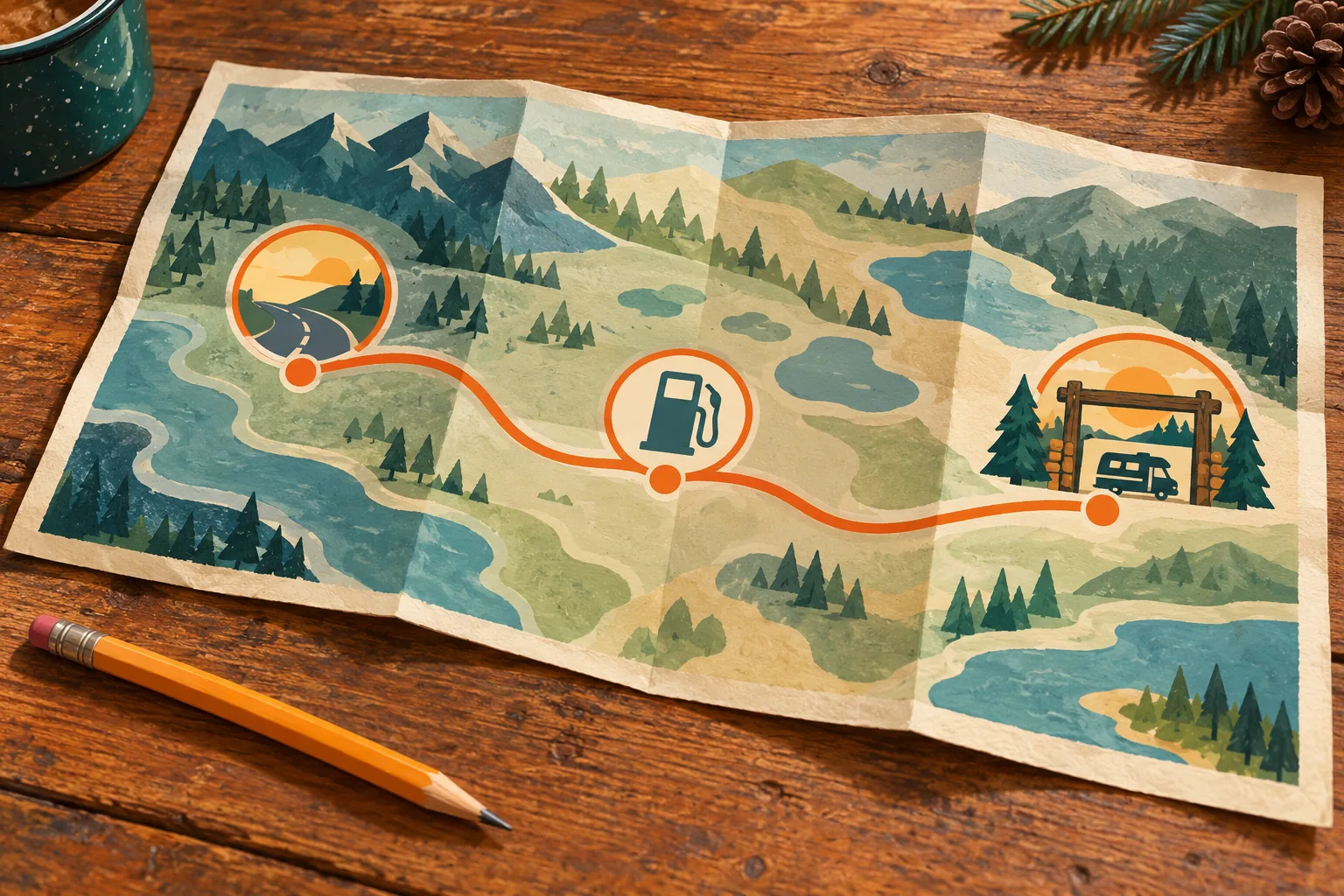
Pass two adds stops your family can use
Place fuel, food, and rest breaks along the workable route. Think about access before thinking about a five-cent fuel difference. A stop needs an entrance you can use, space to maneuver, suitable parking, and a practical exit.
Satellite and street-level imagery can reveal likely problems, but imagery may be old or incomplete. A delivery truck, construction barrier, or crowded lot can change the layout. Where access is uncertain, contact the business or choose a more straightforward stop.
Plan breaks around your family's needs rather than the map's ideal drive time. A short stop can take longer when five people need different things. Leave enough flexibility that an extra bathroom break does not turn the rest of the day into a race.
Choose an alternative before you need it. The backup might be a different fuel stop farther along the confirmed route or a rest area before a difficult stretch. Do not run the plan so tightly that a closed business leaves you without a comfortable option.
Pass three checks the final approach
Zoom in on the last several miles. Confirm the actual campground entrance, not just the center of the property. Look for a separate registration lane, a gate procedure, or an approach the campground specifically warns RVs not to use.
Read the campground's arrival instructions and call if they are unclear. Ask which direction they recommend approaching from with your configuration. A simple question about a left turn or narrow bridge can prevent a difficult arrival.
Save the final instructions offline and share them with the navigator. When you are close, simplify the conversation. The driver needs the next relevant turn and any verified restriction, not a running account of every map alternative.
If you miss the entrance, continue to a safe, legal place to stop or turn around. Avoid making an abrupt maneuver because the screen says you are nearly there. Recovering calmly is part of route planning.
Keep one approved route visible
When two navigation systems disagree, decide which route you intend to follow before moving. A phone that silently reroutes to save a few minutes can undo the planning you just completed.
Record critical roads or waypoints, but do not use waypoints to force a route past a closure or official restriction. If conditions change, stop somewhere appropriate and review the new route with the same care as the original.
The passenger can monitor directions when available. A solo driver should make changes while parked safely. There is no benefit in a detailed planning system that creates distracting work behind the wheel.
Build a reusable route card
A compact card can include:
- Travel configuration and date dimensions were checked
- Destination and confirmed entrance
- Main roads and any essential approach instructions
- Official restrictions checked, with links and review date
- Primary fuel and break stops, plus alternatives
- Expected arrival window and campground contact
- Offline map or saved instructions
- Conditions that would make you delay or choose another overnight stop
If a scenic shortcut has park-road limits that don't clearly fit your rig, check those limits before choosing it. Use the longer, verified route if the shortcut remains uncertain. Another traveler's past trip doesn't establish that your RV can use the road today.
Review once more on departure morning
Check current weather, closures, and destination messages before leaving. Confirm that the selected stops are still part of the route and that the arrival plan still works with your departure time.
Researched practical guide · The RV Dummies · Editorial review: 2026-10-02.
Sources & further reading
Always follow your RV and tow-vehicle manuals. When in doubt, ask a pro.