
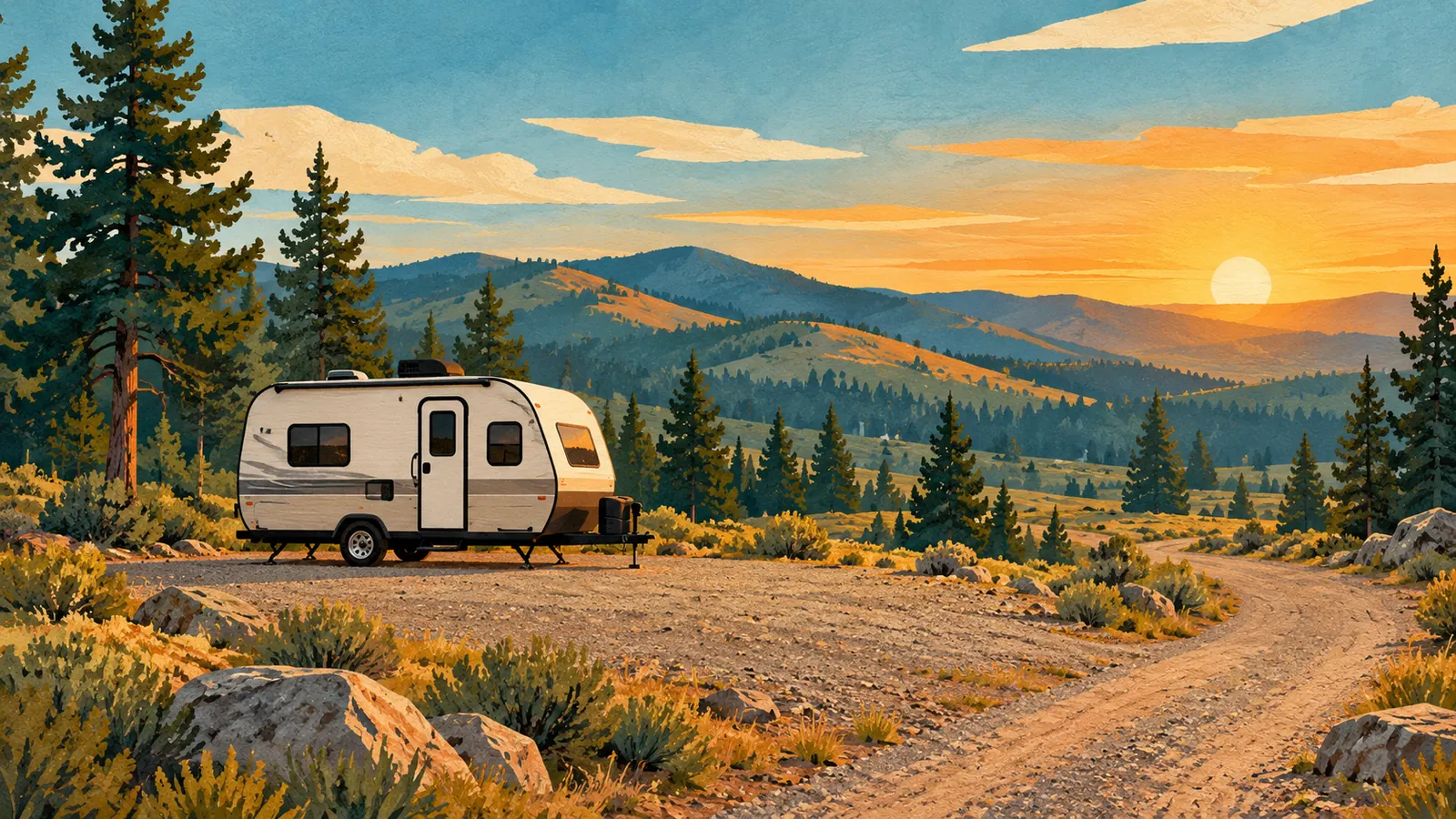
Before driving toward a promising campsite pin, check who manages the land, whether camping is allowed at that exact spot, and whether the access and conditions fit your RV. Public land can include closed areas, private inholdings, designated routes, special permits, and rules that change from one district to the next. A beautiful pin still needs those checks.
The most useful question is specific: “Can this RV use this route and stay at this location on these dates under the current rules?” That is a question an official map, local order, or land-management office can help answer. “Can you camp on public land?” is too broad to finish the plan.
Follow the current official orders, posted restrictions, and directions from the agency responsible for the place you're visiting.
Identify one exact candidate location
Save the coordinates, the access road, and the date of the information that led you there. Keep a screenshot or offline map for reference, but do not assume the saved map reflects current closures.
A campsite name in an app may be informal. Two pins with similar names may describe different areas, and an attractive photograph may have been taken somewhere else. Treat visitor descriptions as leads that need confirmation.
Write down your RV configuration and practical limits before evaluating the candidate. A site that suits a small campervan may be impossible for a longer trailer to reach or turn around in. The number of stars on a review does not answer the access question for your vehicle.
Confirm the land manager and boundaries
Use official land-management maps and the responsible agency's location information. Determine whether the candidate is on BLM land, a national forest, a park, state land, or private property. Then identify the local office or district that administers it.
Do not assume that a road crossing public land gives permission to park anywhere beside it. Boundaries, access rights, and recreation rules are distinct questions. If the map is unclear, contact the responsible office with the coordinates rather than trying to settle the boundary from a casual online description.
Save the office's official contact details and the relevant page. Return to that source if travel apps disagree about the location or its rules.
Read the local rules before the general summary
First identify whether you're looking at a developed campground, a dispersed camping area, or a long-term visitor area, then find the rules for that exact destination. BLM's national camping guidance explains those categories and emphasizes that local restrictions vary. BLM camping overview
Check current closure notices, supplemental rules, recreation orders, permit requirements, and seasonal access information. A regional tourism page may be useful for ideas but may not contain the controlling details.
Save the official page and the date checked. If an order includes a map, read the map as well as the text. A restriction can apply to a defined corridor or recreation area rather than an entire state, and the boundary can determine whether your chosen pin is usable.
Do not export one area's stay limit to another
A repeated number can sound universal when it is not. Colorado and New Mexico illustrate why you should keep the complete local rule rather than remembering only “fourteen days.”
BLM's Colorado camping-and-occupancy fact sheet states a fourteen-day limit within a thirty-day period at one location and a move of at least thirty air miles after that limit. BLM's New Mexico recreation information describes a fourteen-day limit within a twenty-eight-day period and a move of at least twenty-five miles. Check each current source and the applicable local orders before using either example. BLM Colorado camping rules and BLM New Mexico recreation rules
The difference matters because a stay limit has more than one part: duration, time window, geographic area, move requirement, and sometimes restrictions on returning. Record all relevant parts. Do not assume a short move to the next visible campsite resets the clock.
Verify the route separately from the campsite
Ask whether the access road is open to your vehicle type and whether current conditions make it suitable. Check seasonal gates, recent weather impacts, turnarounds, surface conditions, and any vehicle-size restrictions through the appropriate sources.
An open route can still be unsuitable for your RV or skill level. A road that was firm in dry weather may behave differently after rain. Satellite imagery cannot tell you the current depth of a rut or whether a washout occurred yesterday.
Do not take a long rig down a questionable road merely to inspect the campsite. Find a safe, lawful way to gather the missing information before committing the combination. If you cannot verify suitable access, choose another location.
Find the actual camping conditions
Ask whether camping must occur in designated sites, whether vehicles must remain within a defined area, and whether a permit or fee applies. Learn the rules for fires, generators, quiet hours, pets, waste, and food storage where applicable.
Keep separate notes for what is required and what is simply preferred by another traveler. A reviewer's habit of parking close to the water is not evidence that the location permits it.
For the first visit, keep the setup modest and use an established permitted site. Do not clear vegetation, create tracks, move natural features, or expand a campsite to accommodate equipment. If your RV does not fit within the allowed area, the site does not fit your RV.
Plan water and waste before leaving town
Identify a verified potable-water source and approved wastewater-disposal location. Confirm operating hours, access, fees, and whether the service is available to non-guests. A dump-station listing can become outdated, and a faucet near a disposal area may not be for drinking water.
Carry out trash and follow the site's current sanitation rules. Do not assume gray-water discharge is allowed because another camper did it or because a general rule summary seems ambiguous. Ask the local manager about the exact practice you intend and use an approved disposal option when uncertain.
Write the resupply and disposal stops into the route. Self-contained camping still depends on services; they simply happen before and after the campsite instead of at the pedestal.
Include weather and communication in the decision
Look up the forecast for the actual location and understand the route out. Decide where the family would go for dangerous weather and how you would receive official information. A remote view is less appealing when the only exit becomes unusable or there is no practical shelter plan.
Check communication needs honestly. A coverage map or one review cannot guarantee your phone or work connection will function at the site. If reliable connectivity is essential, choose a location where you can test it without stranding the rest of the plan.
Share appropriate trip details with a trusted contact before heading into an area with limited service. Include the expected return or check-in arrangement your family has chosen. Keep private location information out of public posts while you are using it as an active itinerary.
Decide whether this site works
Keep these details together:
- Exact coordinates and managing office
- Official map and current orders checked
- Camping permission, permit, fee, and stay-limit details
- Approved access route and current condition information
- Rig fit and a practical turnaround
- Water, wastewater, and trash plan
- Weather shelter or relocation plan
- Communication needs and fallback location
- Date checked and unresolved questions
If permission or access is still unclear, keep researching or choose another site before you set up.
Researched practical guide · The RV Dummies · Editorial review: 2026-10-02.
Sources & further reading
Always follow your RV and tow-vehicle manuals. When in doubt, ask a pro.